
VA HISA Grant Contractor for Disabled Veteran Home Modifications
What if the contractor who builds your modification isn’t the person who decides whether HISA will cover it? That distinction matters. If you’re searching for a VA HISA grant contractor for disabled veteran home modifications, you may want a clear path from medical need to safer, more accessible living. The VA determines eligibility and medical necessity. A contractor helps turn the approved work into a practical construction plan. Knowing who handles each step can make the process easier to manage.
HISA may support medically necessary changes such as ramps, roll-in showers, or widened doorways, but the VA reviews the application and proposed scope. This article explains what HISA may cover, how medical documentation and a contractor estimate fit into planning, and how to prepare for construction while considering household routines. Coastal Contracting is a family-owned Richmond-area Class A general contractor with more than 20 years in operation and experience in aging-in-place and ADA remodeling. Its construction planning keeps the home and the approved scope at the center of the project, without promising VA approval or funding.
Key Takeaways
- Learn how HISA, SAH, and SHA differ so you can focus on the program that fits the home adaptation need.
- Understand why the VA decides eligibility and medical necessity, while construction planning follows the approved scope.
- See what to organize before planning work, starting with guidance from the veteran’s VA care team and current HISA instructions.
- Discover how a VA HISA grant contractor for disabled veteran home modifications can translate an approved scope into practical accessibility-focused construction.
- Explore how aging-in-place and ADA-compliant remodeling can support a coordinated project in Richmond, Henrico, Goochland, Midlothian, Chesterfield, Short Pump, Chester, Glen Allen, Hanover, Ashland, and Montpelier.
What Is the VA HISA Benefit for Disabled Veteran Home Modifications?
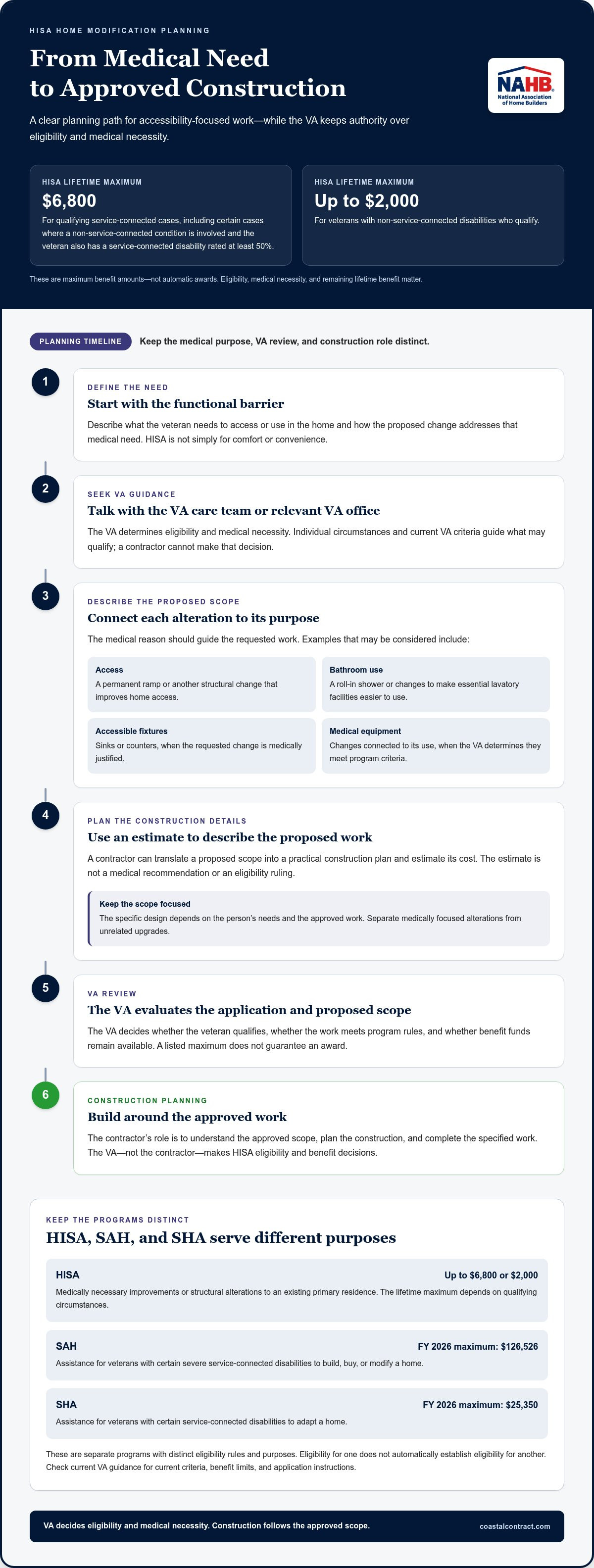
The Home Improvements and Structural Alterations benefit, commonly called HISA, helps eligible veterans pay for medically necessary improvements or structural alterations to their homes. The purpose is practical: to improve access, support essential bathroom use, or accommodate needs related to medical equipment. A modification isn’t covered simply because it makes a home more comfortable or convenient. The VA evaluates the medical need and decides whether the veteran qualifies and whether the proposed work meets program rules.
HISA has lifetime limits that depend on a veteran’s circumstances. Under current VA guidance, the maximum is up to $6,800 for qualifying service-connected disabilities, including certain cases involving a non-service-connected condition when the veteran also has a service-connected disability rated at least 50%. Veterans with non-service-connected disabilities may qualify for up to $2,000. These are maximum benefit amounts, not automatic awards. Eligibility, medical necessity, and available lifetime benefit all matter.
What kinds of home changes may HISA support?
VA guidance describes access improvements and changes that make essential parts of the home usable. The medical reason should guide the scope. A contractor can help plan construction around the VA-approved work, but can’t determine that a particular change is medically necessary or HISA-eligible.
Examples may include:
- A permanent ramp or other structural change that improves access to the home.
- Bathroom alterations, such as a roll-in shower or changes that make essential lavatory facilities easier to use.
- Accessible sinks or counters, where the requested change is medically justified.
- Modifications connected to the use of medically necessary equipment, when the VA determines they meet the program’s criteria.
The specific design depends on the person’s needs and the approved scope. For example, bathroom planning may consider how a veteran enters and uses the space, not just the appearance of new fixtures. A clear scope helps keep construction focused on the stated medical purpose instead of combining eligible work with unrelated upgrades.
Who should answer HISA eligibility questions?
For questions about eligibility, medical necessity, and benefit decisions, start with the veteran’s VA care team or the relevant VA office. Individual circumstances and current VA criteria determine what may qualify. A contractor’s estimate can describe proposed construction and its cost, but it isn’t a medical recommendation or an eligibility ruling.
That distinction matters when selecting a VA HISA grant contractor for disabled veteran home modifications. The contractor’s role is to understand the approved scope, develop a clear construction plan, and complete the specified work. Coastal Contracting’s aging-in-place and ADA remodeling experience supports practical accessibility-focused construction for homeowners in the Richmond area, while HISA decisions remain with the VA.
Which Home Modifications Fit HISA, and How Does It Differ From SAH or SHA?
Choosing the right program starts with the reason for the work, not the size of a renovation wish list. HISA focuses on medically necessary improvements to an existing primary residence. SAH and SHA are separate housing grant programs for veterans with qualifying service-connected disabilities, and each has distinct eligibility rules and purposes. The programs aren’t interchangeable, so review current VA guidance before building a project plan.
| Program | Purpose and general scope | Who determines eligibility |
|---|---|---|
| HISA | Medically necessary improvements or structural alterations to an existing primary residence. Lifetime maximums are up to $6,800 for qualifying service-connected cases and up to $2,000 for non-service-connected cases. | The VA, through the veteran’s healthcare system and applicable program review. |
| SAH | Assistance for veterans with certain severe service-connected disabilities to build, buy, or modify a home. FY 2026 maximum: $126,526. | The VA under SAH program criteria. |
| SHA | Assistance for veterans with certain service-connected disabilities to adapt a home. FY 2026 maximum: $25,350. | The VA under SHA program criteria. |
These are program maximums, not guaranteed awards. The VA’s overview of VA disability housing grants like SAH and SHA explains the distinct programs. Check current VA pages for the latest eligibility criteria, benefit limits, and application instructions because qualifying circumstances and eligible work differ by program.
How HISA differs from SAH and SHA
Think of HISA as a healthcare benefit tied to a documented medical need in the home. SAH and SHA address broader housing adaptations for veterans who meet their specific disability criteria. Eligibility under one program doesn’t automatically establish eligibility under another. The VA, not a construction company, makes each program’s eligibility and benefit decisions.
How to frame a project around medical need
Describe each proposed change in terms of the functional barrier it addresses, then work with the VA care team to understand how that need should be documented. For example, an accessible bathroom scope should connect specific alterations to essential use rather than bundle them with unrelated finishes or a full-room redesign. Practical aging-in-place and ADA remodeling can help translate an approved scope into thoughtful construction.
VA guidance identifies some changes that may qualify when medically justified, including permanent access ramps, essential bathroom alterations, and certain sink, counter, plumbing, or electrical changes. Similar-looking projects may be treated differently depending on the veteran’s medical circumstances and the VA’s review. Keep the scope tied to the documented need.
HISA generally excludes work such as exterior decking, hot tubs, new construction, and routine maintenance. Portable ramps and stair glides are also excluded under the current guidance summarized here. Separate these items from potentially eligible work, and follow current VA instructions before making decisions. A VA HISA grant contractor for disabled veteran home modifications can plan and build the approved construction scope, but cannot turn general remodeling preferences into VA-approved work.
What Should You Expect From a VA HISA Grant Contractor?
A contractor can turn an approved modification into a clear construction plan. A contractor cannot determine medical necessity, decide whether you qualify for HISA, or guarantee that the VA will approve or fund the work. Those decisions belong to the VA. Keeping the roles clear helps prevent confusion as you move from medical documentation to planning and construction.
Once you have the VA’s decision and approved scope, the contractor’s job is to plan and complete the construction described there. The estimate and project plan should align with current VA instructions and the approved work. If a proposed change goes beyond that scope, pause before including it as HISA-funded work and follow the VA process for direction.
What a contractor can do during project planning
Construction planning starts with the home and the approved work. A contractor can review the affected area, discuss how the modification fits the existing layout, and explain the construction in straightforward terms. Clear documentation makes it easier to compare the proposed work with VA paperwork and understand what the project includes.
- Translate the approved modification into a defined construction scope and estimate.
- Identify practical features of the home’s layout that affect completing that scope.
- Plan accessible remodeling details around the approved work and the household’s routines.
- Coordinate construction activities with you and communicate what work is planned and where it will take place.
For example, an approved bathroom alteration may involve work in more than one part of the room. A contractor can explain how the listed changes fit together and plan the sequence, while keeping the estimate aligned with the VA-approved scope. If you’re also considering comfort and access elsewhere in the home, Coastal Contracting’s aging-in-place remodeling offers a construction-focused approach to accessibility improvements.
What remains the VA’s responsibility
The VA determines eligibility, medical necessity, applicable benefit limits, and whether a proposed project is approved. A contractor’s assessment of the home is not a medical recommendation, and an estimate is not an approval notice. A well-prepared construction plan cannot promise reimbursement or a particular funding outcome.
Before authorizing work, follow the current VA instructions for the veteran’s application and approval. If the scope or circumstances change, don’t assume the original decision automatically covers the revision. Follow the relevant VA process, then make sure the construction plan reflects the direction received. This helps keep the benefit process and building work in step.
When choosing a VA HISA grant contractor for disabled veteran home modifications, focus on the construction role: can the contractor explain the scope clearly, coordinate the work attentively, and deliver accessibility-focused remodeling? Coastal Contracting is a family-owned Richmond-area Class A general contractor with more than 20 years in operation and experience in aging-in-place and ADA-compliant remodeling. The company handles thoughtful project execution, while VA decisions stay with the VA.
How to Prepare a HISA Home Modification Project in Richmond, Virginia
Preparation can make the transition from VA review to construction clearer and less disruptive. Richmond-area veterans should follow the instructions that apply to their own VA care and HISA application. A process described for another VA healthcare region may not apply to your case. Use the VA’s current direction as your starting point, then prepare the home and household for planning.
Before requesting construction planning
Start with the veteran’s VA care team and current HISA instructions. Ask what medical documentation is needed, how to submit it, and what the VA requires before work can be approved. Keep prescriptions, application materials, written decisions, and scope descriptions together. If the home is rented, review the current instructions for any required owner authorization before planning construction.
- Clarify the VA process. Confirm the applicable instructions with the care team or relevant VA office. The application may require a physician’s prescription describing medical necessity, an itemized contractor estimate, and photographs of the area. Follow the current requirements for your case.
- Record the barriers at home. Note where access or daily use is difficult, such as reaching an entry, moving through a doorway, or using essential bathroom fixtures. Describe what happens in the space and which areas are affected.
- Gather useful site information. When appropriate, record basic room or doorway measurements and identify obstacles that may affect the proposed work. These notes can help prepare for a site review, but they don’t replace a contractor’s assessment or VA documentation.
- Coordinate people and property needs. Identify who needs to be involved, including the homeowner, landlord, or property manager where relevant. Discuss access to the affected area and household routines that construction planning should account for.
- Review the approved scope with the contractor. Once the VA clarifies or approves the work, compare the estimate and construction plan with the written scope. Resolve differences through the appropriate VA instructions before authorizing work.
- Check local project requirements. The property’s jurisdiction may affect permitting or other construction requirements. Identify the city or county responsible for the address and verify applicable details with that local authority before work begins.
After the VA clarifies the scope
Use the planning conversation to discuss how the work will fit the home and daily routines. For a bathroom modification, review the affected area, access to essential fixtures, and how construction activities can be coordinated around the household. Coastal Contracting’s kitchen and bathroom remodeling experience offers relevant construction context, while the VA remains responsible for benefit decisions.
A VA HISA grant contractor for disabled veteran home modifications should explain the estimate in plain language and keep construction planning aligned with the VA-approved scope. Share relevant written instructions and raise questions about any mismatch before authorizing the project. For an accessibility-focused remodel in the Richmond area, discuss your home modification project with Coastal Contracting.
Accessible Home Modifications With Coastal Contracting in the Richmond Area
Accessible remodeling is about making the home work better for the person who lives there. The right construction details depend on the approved scope, the existing layout, and how the household uses each space. Coastal Contracting is a family-owned Richmond-area Class A general contractor that has been operating for over 20 years, with experience in aging-in-place and ADA-compliant remodeling. That background supports careful planning and project coordination for accessibility-focused residential work.
The VA makes HISA eligibility and funding decisions. Coastal Contracting handles the construction: understanding the scope, planning the work, and carrying it out. The company doesn’t determine medical necessity or guarantee HISA approval. Keeping these responsibilities distinct helps you plan with realistic expectations and understand who handles each part of the process.
How accessible remodeling supports daily living
A thoughtful modification considers how a person moves through and uses the home, not just how a finished room looks. Depending on the approved scope, planning may account for access to an entry, movement through an affected area, or everyday use of essential bathroom fixtures. The details should fit the home and household rather than rely on a one-size-fits-all design.
Bathroom remodeling is one practical example. If the approved work involves changes to an essential bathroom area, the construction plan can focus on how the documented modifications fit the existing layout and how the work will be coordinated. VA approval remains separate from construction, and no remodeling choice by itself guarantees a medical or funding outcome.
Coastal Contracting plans each project according to its scope and home. Clear communication helps keep the homeowner informed about planned work and gives the project a steady structure. Discussing household routines before construction can help the team plan around how affected areas are used while staying aligned with the approved work.
Discuss your Richmond-area project with Coastal Contracting
Coastal Contracting serves Richmond and nearby communities, including Henrico, Goochland, Midlothian, Chesterfield, Short Pump, Chester, Glen Allen, Hanover, Ashland, and Montpelier. When discussing a home modification, share your goals, describe the access challenges you’re addressing, and bring relevant VA scope documents or written instructions. These materials help focus the construction conversation on the work the VA has approved rather than an unrelated renovation wish list.
If you’re looking for a VA HISA grant contractor for disabled veteran home modifications, focus on a partner who can explain the construction scope clearly and coordinate the work carefully. Coastal Contracting brings local residential construction experience and aging-in-place and ADA-compliant remodeling to the project, without taking the place of the VA’s benefit decisions. You can discuss the home, approved scope, and practical construction questions together.
For an accessible remodeling project in the Richmond area, talk with Coastal Contracting about your home modification. A conversation about your goals and relevant VA documents can provide a thoughtful starting point for construction planning.
Take the Next Step Toward a More Accessible Home
A well-planned home modification can give you a clearer path from an approved scope to construction decisions that reflect daily life. Before moving ahead, consider what you want the affected space to make easier, which household routines need consideration, and what project details you’d like explained. Bringing those priorities into the conversation helps keep planning personal and practical.
If you’re considering a VA HISA grant contractor for disabled veteran home modifications, Coastal Contracting can discuss the construction side of your accessibility-focused project. Share your goals and relevant VA scope documents so the conversation can focus on the work, the home, and practical planning. The VA remains responsible for benefit decisions; Coastal Contracting handles remodeling and project execution.
Discuss your accessible home modification project with Coastal Contracting. A careful first conversation can help you take the next step with greater clarity.
Frequently Asked Questions
Can I use HISA for modifications to a rented home?
Yes, a rented home may qualify if the veteran meets HISA criteria and the proposed work is approved. The VA’s application instructions require a notarized statement from the property owner authorizing the work when the veteran rents. Get that permission before the project proceeds, and ask the VA care team or relevant office how to include it with the application. The owner’s consent alone doesn’t establish HISA eligibility.
Can HISA pay a contractor directly?
Don’t assume the VA will pay your contractor directly. Payment arrangements depend on the VA’s current HISA instructions and the veteran’s case, so ask the VA office handling the application how approved funds are issued and what documentation is needed. Before signing an agreement, make sure you understand who is responsible for paying the contractor and when. A contractor can provide an estimate, but can’t set the VA’s payment terms.
Can construction begin before the VA approves a HISA project?
If you intend to use HISA for the work, wait for the VA’s approval and follow its current instructions before authorizing construction. Starting early could leave you responsible for work the VA hasn’t approved. If there’s an urgent access concern, explain it to the veteran’s VA care team and ask what steps are appropriate. Keep written approval and the approved scope available when discussing the construction plan with your contractor.
Does HISA cover home medical equipment itself?
HISA is for medically necessary home improvements and structural alterations, not generally for buying medical equipment itself. A home change related to using equipment may be considered separately from the equipment purchase. For example, a structural alteration that supports access may be reviewed under HISA, while the device may fall under a different VA healthcare benefit. Ask the veteran’s care team which program applies before including equipment in a project estimate.
What happens if the VA does not approve a proposed HISA modification?
If the VA denies the request, ask the office handling the application to explain the decision and identify any missing documentation or scope concerns. Don’t treat a contractor’s estimate as permission to proceed with HISA-funded work. You can ask the VA what options are available, such as submitting additional information or revising the request. Before proceeding outside the benefit, review the construction scope and payment responsibility carefully.
Can a family member or caregiver help coordinate a HISA project?
Yes, a family member or caregiver can help organize documents, record access concerns, and join conversations about the home, with the veteran’s involvement and consent. They can also help communicate household routines that may affect construction planning. For projects in Richmond, Henrico, Goochland, Midlothian, Chesterfield, Short Pump, Chester, Glen Allen, Hanover, Ashland, or Montpelier, keep VA decisions and contractor planning distinct as you coordinate locally.
Is HISA the same as an SAH or SHA grant?
No. HISA, SAH, and SHA are separate VA programs with different purposes, eligibility criteria, and application processes. HISA focuses on medically necessary home improvements or structural alterations, while SAH and SHA support certain housing adaptations for veterans who meet their specific disability criteria. Eligibility for one program doesn’t automatically qualify someone for another. Review current VA guidance or contact the relevant VA office to identify the program that fits your circumstances.
How long does the HISA approval and construction process take?
The VA is required to decide on a complete HISA application within 30 days of receipt, according to current guidance. That decision period is not the same as the full project timeline. Preparing documentation, obtaining owner authorization if renting, finalizing construction details, and completing the work can take additional time. Ask the VA whether your application is complete, and discuss construction scheduling with your contractor after the scope is approved.