

Class A general contractor permit process in Hanover County VA
That’s the state licensing cost. Hanover County building permit fees are separate and based on estimated construction cost, excluding mechanical, electrical, and plumbing costs.
The license fee is only one part of project planning. It’s easy to confuse a contractor license with permits for specific construction work, but understanding the difference helps you prepare the right applications and budget for each cost.
This guide covers Class A license requirements, Hanover County permit application steps, and local fees and documents that may apply. You’ll also see how the type of work and site conditions can affect permitting, helping you plan your next steps.
Key Takeaways
- Budget separately for the Virginia Class A license application and annual business registration, as Hanover County building permit fees are a different cost.
- Hanover County permit fees are based on estimated construction cost, excluding mechanical, electrical, and plumbing costs; complete plans and site documents help prepare an application.
- Allow for both state license processing and local permit review, which follow separate timelines and depend on complete submissions.
- A Class A license requires a Designated Employee who passes the General, Virginia, and Advanced exam portions.
- For commercial work, be ready to provide a valid Virginia contractor license and the required project and site approvals with the permit application.
How much does a Virginia general contractor license cost?
These state licensing charges are separate from Hanover County building permit fees, which are calculated independently. Class A has no project-cost or annual-project limit, unlike Classes B and C. Account for the correct license class before preparing a permit application.
Contractor license classes help indicate which projects a contractor may undertake. Class A has no project or annual limit; Class B allows up to $129,000 per project and $750,000 annually. Class C allows up to $10,000 per project and $150,000 annually. Class A applicants must also meet a $45,000 net worth or equity requirement.
A licensed trade requirement applies to electrical, plumbing, HVAC, and gas work. The owner-builder exemption covers general contractor licensing only, not the qualifications required for regulated trades. If your project includes new wiring, plumbing changes, heating or cooling work, or gas service, use appropriately licensed tradespeople for that work. Practicing a regulated Virginia trade without a license is a Class 1 misdemeanor.
The owner-builder exemption allows an owner to act as general contractor for one primary residence for the owner’s use during any 24-month period. Before the building permit is issued, the owner must file a written statement under Virginia Code §54.1-1111 confirming they aren’t subject to contractor licensure. This exemption doesn’t cover projects outside its conditions or replace required trade licenses. Virginia also provides an exemption for an owner building on their property as a bona fide gift to an immediate family member who will live there.
Verifying a license through DPOR is a practical way to confirm a contractor’s or tradesperson’s Virginia credential. Search the Virginia Department of Professional and Occupational Regulation’s license records using the person’s or business’s identifying details. Match the listed name and license information to the contractor or trade professional you plan to hire. For a commercial building permit in Hanover County, contractors must provide a copy of a valid Virginia contractor license.
Keep licensing separate from project permitting. A Class A credential establishes the contractor’s state license class; a building permit covers the proposed construction. Hanover County requires building permit applicants to submit plans and specifications, plus a plot plan showing the proposed structure and dimensioned setbacks. Commercial work also requires an approved site plan or proof of site-plan approval. Organize licensing and project documents as separate application items to avoid confusing a missing credential with an incomplete permit package.
Virginia exempts an owner building a home on the owner's own property as a bona fide gift to an immediate family member who will live in it from contractor licensing under §54.1-1101(A)(8).
Permit costs and additional fees
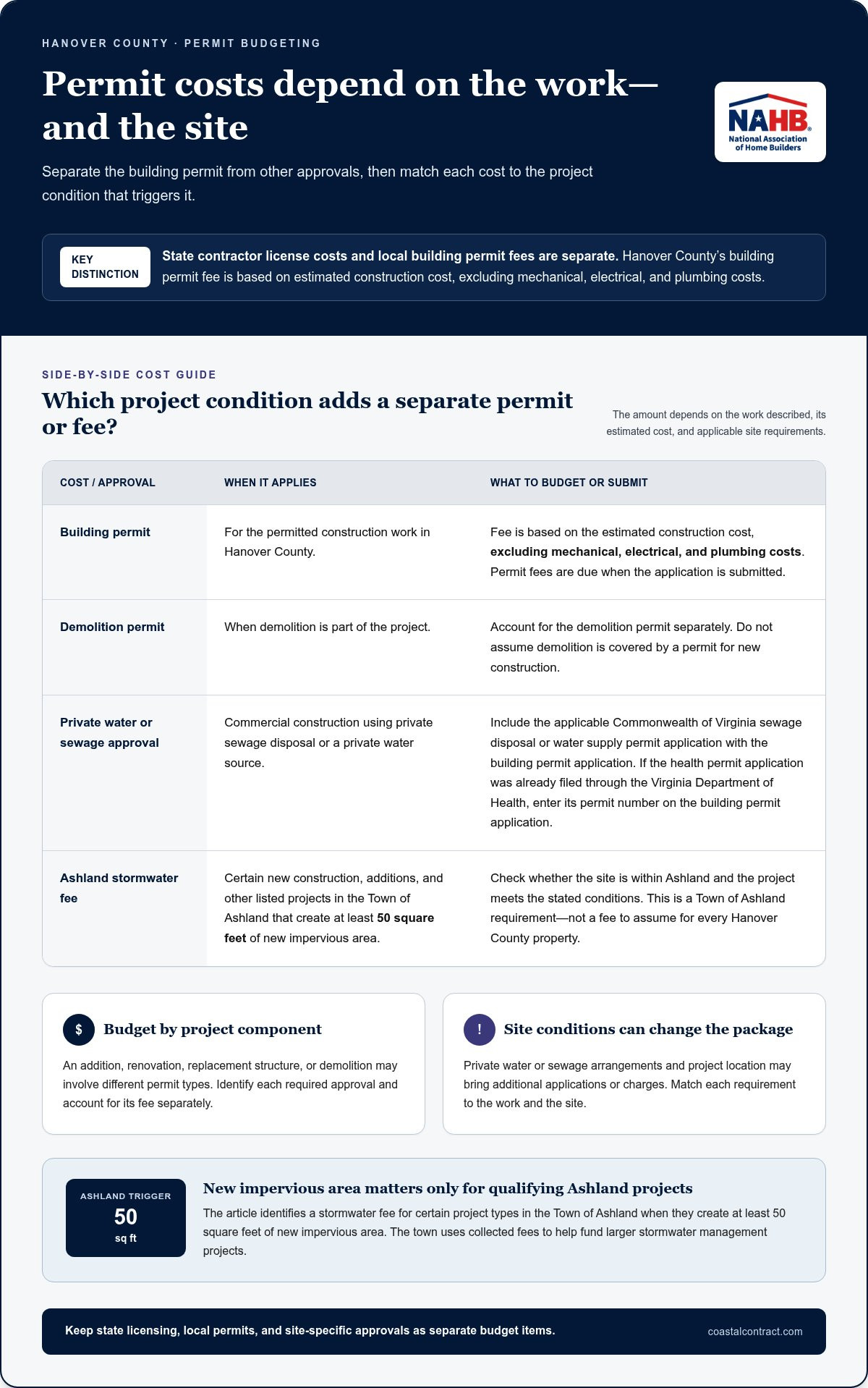
A Hanover County building permit fee is based on the estimated construction cost of the permitted work, excluding mechanical, electrical, and plumbing costs. In the Class A general contractor permit process in Hanover County, VA, local permit charges are separate from state contractor license costs. Permit fees are due when you submit the application, so include them in your permit budget. The amount depends on the work described and its estimated cost.
Include this cost when demolition is part of the project; don’t assume it is covered by a permit for new construction. For a building addition, renovation, or replacement structure, identify each required permit type and account for its fee separately. The demolition fee applies to the demolition permit itself.
The actual requirements and applicable charges depend on the site’s sewage arrangements. For commercial construction in Hanover County using private sewage disposal or a private water source, include the applicable Commonwealth of Virginia sewage disposal or water supply permit application with the building permit application. If you have already filed the health permit application through the Virginia Department of Health, enter its permit number on the building permit application.
A stormwater fee helps address runoff associated with certain construction that adds impervious area. In the Town of Ashland, fees apply to certain new construction, additions, and other listed projects creating at least 50 square feet of new impervious area. Ashland uses collected fees to help fund larger stormwater management projects. This is a Town of Ashland requirement, not a countywide fee to assume for every Hanover County property. Determine whether the project is within Ashland and whether it falls within the described project types.
To budget for the Class A general contractor permit process in Hanover County, VA, separate charges by approval and project condition:
- Building permit: Based on estimated construction cost, with mechanical, electrical, and plumbing costs excluded.
- Private water or sewage: Attach the applicable state permit application for qualifying commercial construction.
- Ashland stormwater: Account for the fee when qualifying work creates at least 50 square feet of new impervious area.
Before submitting, match each charge to the work and location it covers. A home addition may require a building permit, while demolition or private sewage may call for separate approvals. Submit permit fees with the application and organize supporting applications by project component. This makes the cost basis clearer and helps prevent separate permit requirements from being overlooked.
Permit processing timelines
A permit processing timeline is the period from application submission through review and approval. For rural Virginia counties, the cited processing range is 2-5 weeks. The Class A general contractor permit process in Hanover County VA includes local review, but the state contractor license application follows a separate timeline. Treat these as distinct milestones rather than one combined waiting period.
A properly completed Virginia contractor license application takes an average of 30 days to process. This is the state licensing timeline, not Hanover County’s building permit review period. If a contractor already holds a valid license, that application stage may not be part of the project schedule. If the license is still being obtained, track its progress separately from county permit preparation.
For the Class A general contractor permit process in Hanover County VA, the first local timing checkpoint is application completeness. Hanover County won’t accept an incomplete building permit application. Residential applicants need one set of plans and specifications, plus one plot plan showing the proposed structure and dimensioned setbacks. Assemble these documents before submitting to provide a complete package.
Commercial applications require additional preparation. Hanover County requires one set of plans, one copy of specifications, one copy of calculations, and one copy of the soil report. The application also needs details such as construction type, use group, square footage, GPIN numbers, district, and traffic zone. Include an approved site plan or proof that the site plan, variance, or conditional use permit has been approved.
Project revisions can alter the schedule. Hanover County may require applicants to cancel and reapply when a revision changes more than 20% of the project. Keep plans consistent with the intended scope, and coordinate substantial changes before updating an active application. A change affecting a large portion of the work can require a different application path, rather than a simple drawing adjustment.
Inspection scheduling is a separate milestone after permit issuance, once work reaches an inspection stage. Most localities provide online inspection scheduling and require 24-48 hours’ notice. Include that notice period when coordinating the next phase of work, so a following trade isn’t scheduled before the inspection can occur. An inspection appointment is not part of the initial permit review timeline.
Track each stage separately to keep the project sequence clear:
- State license: Allow an average of 30 days for a properly completed application.
- County permit: Plan around the 2-5-week rural Virginia county processing range, with complete documents submitted.
- Revisions: A change exceeding 20% may require cancellation and a new application.
- Inspections: Allow for the typical 24-48-hour notice described for most localities.
This schedule separates application preparation, review, revisions, and inspections. Each stage has its own trigger, so map them to the project sequence rather than treating permitting as a single wait. A complete submission and coordinated scope provide a clearer basis for planning the work that follows.
Qualified Individual and Designated Employee requirements
A Qualified Individual is the person whose qualifications support a contractor license application. A Designated Employee is the person identified for the Class A license exam requirement. These terms refer to individual licensing roles, not Hanover County building permit documents. Review the Virginia Department of Professional and Occupational Regulation application carefully to identify the required person and supporting details.
For a Virginia Class A contractor license, the Designated Employee must pass the General, Virginia, and Advanced portions of the examination. All three are required. Passing only the General portion, for example, doesn’t satisfy the Class A exam requirement. Plan for the exam as part of the state licensing process, separate from preparing construction plans or applying for a Hanover County building permit.
The Qualified Individual and Designated Employee labels can raise practical questions during application preparation. Start by reviewing the current DPOR application and instructions. Identify which person belongs in each required field, then keep names and qualification information consistent across submitted materials. Don’t assume that experience in a particular trade replaces the Class A exam requirement. The required portions are General, Virginia, and Advanced.
Use a simple preparation sequence:
- Read the application: Locate the sections identifying the Qualified Individual and Designated Employee.
- Confirm the exam role: Make sure the person designated for the Class A exam requirement is prepared for all three portions.
- Organize the application: Keep the individual’s identifying and qualification details aligned across the forms.
- Separate state and county steps: Treat DPOR contractor licensing and Hanover County building permits as different processes.
A properly completed Virginia contractor license application takes an average of 30 days to process. That average makes complete, internally consistent application materials useful for planning. It does not replace the examination requirement. Keep exam preparation and application processing on separate schedule lines, especially if a project’s permit submission depends on the contractor’s license documentation.
Virginia contractor licenses expire every two years. DPOR notifies contractors about renewal around 60 days before expiration. Record the license expiration date and renewal notice window alongside the business’s licensing records. Renewal planning helps keep an existing credential from being overlooked while staff focus on active construction applications.
For Hanover County commercial building permits, contractors must provide a copy of a valid Virginia contractor license. The county permit package therefore depends on having the state credential current and ready. Before submitting commercial plans, match the license copy to the contractor named in the permit application. If a Designated Employee’s exam or licensing application is incomplete, address that state requirement before treating the county permit paperwork as ready.
These steps connect individual qualifications, the state license, and the county permit submittal without confusing their separate purposes. For projects that include aging-in-place or ADA remodeling, organize the contractor’s credential and project documents before permit review.
Contractors must
A Hanover County contractor’s license is a local business requirement for specified contractors and tradespeople. Contractors, electrical contractors, plumbers, and steam fitters must obtain one. State contractor registration and county business licensing are separate obligations, so account for both when preparing to work in Hanover County.
Local gross receipts and business connections affect the county license requirement. Contractors, electrical contractors, plumbers, and steam fitters with more than $100,000 in gross receipts must apply if they meet at least one of the county’s stated place-of-business or residency conditions. A contractor based and licensed in another locality may be exempt until Hanover County receipts reach $25,000; an application is required if receipts exceed that amount. Review the rule that matches your business situation.
A state-registration affidavit is a written acknowledgment required in a specific contractor-registration situation. In Hanover County, a person who isn’t state-registered as a Class A, B, or C contractor must sign an affidavit acknowledging state registration is required to undertake or bid on a job of $1,000 or more. This local affidavit doesn’t replace the state license; it addresses the unregistered person’s acknowledgment of the requirement.
Business registration is the county’s record of a business operating locally. All businesses operating in Hanover County must register with the Commissioner of the Revenue and file and pay personal property taxes on business equipment. Businesses also file an annual form with the Commissioner of the Revenue on or before May 1. A county business license must be renewed annually by March 1, unless another renewal date applies.
Hanover County’s business license tax is based on prior-year gross receipts for businesses above the stated threshold. If receipts exceed $100,000, the county assesses $0.10 per $100 of prior-year gross receipts. Track receipts separately from construction project costs, since this tax concerns business revenue rather than a particular permit application.
An asbestos certification form documents asbestos-related compliance for specified commercial work. Hanover County requires the form for renovation, demolition, and reroofing on structures built before January 1, 1985. Confirm the building’s construction date in project records and include the form when the work and building age meet this requirement.
Virginia requires workers’ compensation coverage for employers with more than two employees, including subcontractors. General liability insurance isn’t required for general contractors under Virginia’s stated rule, although coverage may be required for certain permits. If a project involves several employees or subcontractors, include the workers’ compensation requirement in contractor compliance planning.
Use this compliance sequence before bidding or mobilizing:
- Identify state registration and Hanover County license requirements.
- Register the business and track county filing and renewal dates.
- Review project-specific requirements, including asbestos documentation for qualifying commercial work.
- Account for employee and subcontractor coverage obligations.
For project planning that involves construction coordination alongside local compliance steps, discuss your general contracting project.
Coastal Contracting: General Contracting
Coastal Contracting provides general contracting for residential and commercial construction and remodeling projects. If you’re planning a home addition, exterior update, or interior renovation, its team can help carry the work forward from the project scope to construction. General contracting can be a practical fit when several parts of a project need to come together under one coordinated plan. For example, an addition may involve changes to both the home’s exterior and interior, while a remodeling project may focus on one area. The right next step is to discuss the work you’re planning and what you want to accomplish. For general contracting, home additions, or remodeling, contact Coastal Contracting.
Move Your Project from Planning to Progress
Permitting is one part of a successful construction project. The next step is to turn your goals into a clear scope of work, including how the finished space should function and feel. Planning the Class A general contractor permit process in Hanover County, VA, alongside the project helps keep both efforts connected from the start.
Coastal Contracting offers general contracting for projects that need construction coordination, including home additions and exterior remodeling. Whether you’re preparing to expand your home or update its exterior, a conversation about the work can help establish a practical path forward. The focus should be on your priorities, the project’s scope, and how the pieces fit together.
Contact Coastal Contracting today to discuss your project. With a thoughtful plan and the right next steps, you can move forward with confidence.
Frequently Asked Questions
What does a Virginia Class A general contractor license allow, and what are the requirements?
A Virginia Class A license allows a contractor to undertake projects without a project-cost or annual-project limit. Applicants must meet a $45,000 net worth or equity requirement, and the Designated Employee must pass the General, Virginia, and Advanced exam portions. The license doesn’t replace project-specific building permits or licenses required for regulated trades.